Bucket elevators are a quiet backbone of bulk material handling across many industries — from agriculture and mining to cement, food processing, and chemicals. These vertical conveyors, composed of a series of buckets attached to a belt or chain, enable efficient, continuous elevation of powders, granules, pellets, and other bulk solids. As global industrialization, mechanization of agri-supply chains, and demand for faster material flow intensify, the bucket elevators market has become a central consideration for operations focused on productivity, safety, and throughput.
This article provides a comprehensive 2,000-word market analysis of the bucket elevators industry: the technology and types, key applications, drivers and restraints, regional dynamics, innovation trends, competitive landscape, and future opportunities for manufacturers, end-users, and investors.
Click Here to Download a Free Sample Report
What is a Bucket Elevator? Core Components and Types
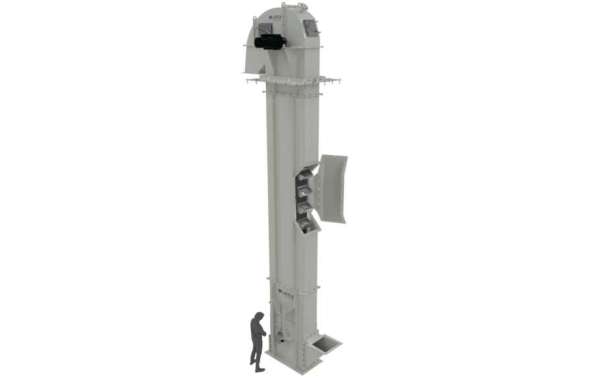
At its simplest, a bucket elevator consists of buckets mounted on a belt or chain loop, driven by a head pulley (or sprocket) and guided by a boot pulley/sprocket. Material is fed into the buckets at the boot, carried vertically, and discharged at the head by centrifugal force or by gravity, depending on design.
Key components:
- Buckets: made of plastic, metal, or composite materials; shaped for the material and discharge method.
- Belt or chain: belt drives are common for lower capacities and gentler handling; chains for heavy-duty, high-temperature environments.
- Casing or housing: protects material flow and personnel; can be bolted, welded, or modular for maintenance.
- Drive system: motor, gearbox, and tensioners; critical for energy efficiency and longevity.
- Inlet and outlet heads: often customizable with dust-tight seals, diverter valves, and discharge chutes.
Common types:
- Centrifugal discharge elevators: discharge material at the head using centrifugal force — ideal for free-flowing materials and high speeds.
- Continuous (gravity) discharge elevators: buckets dump material by gravity — useful for fragile or sticky material requiring gentle handling.
- En-masse (chain) elevators: designed for abrasive, hot, or dense material with heavy-duty chain drives.
Market Overview and End-Use Industries
Bucket elevators serve a wide array of industries:
- Agriculture and grain handling: grain elevators, seed handling, feed mills.
- Mining and minerals: ores, aggregates, coal movement.
- Cement and building materials: clinker, sand, fly ash.
- Food processing: sugar, flour, pulses, snack pellet conveying.
- Chemicals and fertilizers: powders, granules, and bulk solids handling.
- Power generation: coal and biomass handling systems.
- Recycling and waste management: transferring shredded or pelletized materials.
The cross-sector utility of bucket elevators helps insulate the market from demand shocks in any single industry. However, investment decisions are often driven by broader macro trends—urbanization, infrastructure projects, food security initiatives, and industrial automation.
Key Market Drivers
- Increased mechanization in agriculture and grain logistics
Growing production volumes and the need to reduce post-harvest losses drive demand for modern bulk handling systems. Bucket elevators are central to modern grain silos, feed mills, and port terminals. - Infrastructure and construction demand
Cement, sand, and aggregates require efficient vertical transport in plants, fueling elevator demand—especially in developing economies investing in infrastructure. - Automation and Industry 4.0 initiatives
The push for uptime, traceability, and integrated plant control is motivating upgrades from legacy bucket elevators to intelligent, sensor-enabled systems that feed real-time data into plant management systems. - Safety and regulatory compliance
Dust control, explosion protection (ATEX/NEC), and worker safety concerns lead processors to replace poorly enclosed or obsolete vertical conveyors with modern, sealed bucket elevator systems. - Customization and modularization
Manufacturers offering modular, easy-to-install elevators reduce downtime and installation complexity — appealing to small-to-medium enterprises (SMEs) and retrofit projects.
Market Restraints and Challenges
- Competition from alternative technologies
Screw conveyors, pneumatic conveyors, and inclined belt conveyors sometimes substitute bucket elevators—especially when vertical height is moderate or when product characteristics make bucket handling suboptimal. - Wear and maintenance for abrasive materials
Handling abrasive ores or gritty feed accelerates wear on buckets, belts/chains, and casings, increasing lifecycle costs if not properly engineered. - Initial capital expense and retrofit complexity
Upgrading or replacing integrated systems in older plants can be capital intensive and logistically challenging, deterring some buyers. - Energy consumption concern
Although efficient designs exist, heavy-duty elevators can be energy intensive, prompting buyers to weigh lifecycle energy costs.
Technological Trends and Innovations
The bucket elevators market is evolving through technological convergence—materials engineering, digitalization, and manufacturing advances:
- Wear-resistant materials and coatings: Advanced polymers, UHMW linings, ceramic coatings, and abrasion-resistant steels extend component life, reducing downtime.
- Lightweight composite buckets: Reduce load on drive systems and energy consumption while maintaining strength.
- Predictive maintenance via sensors: Vibration, temperature, and belt-tension sensors integrated into drives and housings enable condition-based maintenance, reducing unplanned shutdowns.
- Modular, pre-engineered units: Factory-built sections accelerate installation and simplify spare parts.
- Improved sealing and dust control: Better inlet/outlet designs and filtering reduce dust emissions and comply with environmental regulations.
- Additive manufacturing (3D printing): Rapid prototyping and manufacture of specialized bucket or wear components enable faster customization.
- Automation and system integration: PLC/SCADA interfaces, soft starters, variable frequency drives (VFDs), and load monitoring for optimized energy use.
Design Considerations and Selection Criteria
Selecting the right bucket elevator requires careful matching of product characteristics to elevator design:
- Material flowability and abrasiveness: Determines bucket shape and lining.
- Bulk density and particle size: Influence bucket capacity and drive system sizing.
- Temperature and chemical compatibility: Material selection for belts/chains and buckets.
- Required vertical height and throughput: Affect choice between belt vs. chain and centrifugal vs. continuous discharge.
- Explosion/dust hazard classification: Requires ATEX/NFPA-compliant designs, inerting, and explosion relief.
Serviceability and access, ease of cleaning (critical in food and pharmaceutical environments), and compliance with hygienic standards (e.g., USDA/FDA considerations) are also major factors in procurement.
Regional Dynamics
- North America: Mature markets with a focus on retrofits, safety upgrades, and automation. Demand from grain handling, food processing, and cement remains steady. Emphasis on compliance with safety and emissions regulations drives modern replacement systems.
- Europe: High standards for environment and safety encourage adoption of sealed, low-emission bucket elevators. Automation and energy-efficient designs are prioritized in industrialized nations.
- Asia-Pacific: Fastest growing region due to industrialization, agricultural modernization, and infrastructure projects in countries such as India, China, Indonesia, and Vietnam. Large-scale installations for grain silos, rice mills, and cement plants are common.
- Latin America & Middle East & Africa: Growth in mining, agriculture, and construction pushes demand, though project timelines and investment cycles can be volatile.
Competitive Landscape: Players and Strategies
The bucket elevator market includes a mix of global OEMs, regional fabricators, and specialty manufacturers. Key strategies observed among successful players:
- Vertical integration: Offering complete bulk handling solutions, bundling elevators with conveyors, silo systems, and turnkey installation.
- After-sales services: Providing maintenance contracts, spare parts inventory, and emergency service to lock in long-term relationships.
- Customization and engineering services: Tailoring designs for special materials or corrosive environments to win niche projects.
- Focus on energy efficiency: Marketing low-energy drives and VFD-enabled systems to capture environmentally conscious clients.
- Partnerships with equipment integrators: Collaborating with automation suppliers and systems integrators for bundled projects.
Smaller fabricators often compete on price and local responsiveness, while larger firms differentiate through R&D, certifications, and global service networks.
Opportunities: Where Growth Will Come From
- Retrofit and modernization projects
Existing plants seeking to improve throughput, safety, or compliance represent a steady pipeline of retrofit demand. - Specialty applications
Pharma, nutraceuticals, and high-hygiene food sectors require stainless or sanitary bucket elevators—high-margin niches for suppliers. - Smart elevators and IoT
Adding sensors and cloud analytics provides a new value proposition: reduced downtime and optimized maintenance—an attractive selling point. - Emerging markets infrastructure
Investments in ports, grain export terminals, and cement plants in developing regions create large project opportunities. - Sustainable plant design
As plants seek to reduce dust, spills, and energy consumption, low-emission sealed elevators will gain favor.
Supply Chain and Manufacturing Considerations
The supply chain for bucket elevators spans raw steel, polymer buckets, drive components, bearings, and control electronics. Key considerations:
- Local sourcing vs. importing: Local fabrication reduces lead times but requires skilled welders and precision machining. Imported modular units may be cost-competitive but increase logistics complexity.
- Inventory and spare parts strategy: Critical for industries where downtime carries high penalties (e.g., port terminals, continuous-process plants).
- Quality control: Precision in alignment, welding, and belt/chain assembly directly affects life cycle and safety.
Manufacturers that invest in agile manufacturing, modular designs, and readily available spare parts enjoy competitive advantages.
Sustainability and Regulatory Influence
Environmental regulations on dust emissions and worker safety are shaping elevator designs. Enclosed casings, dust collectors, and emissions-reducing features are increasingly required. Additionally, lifecycle costs and energy footprints are being emphasized by plant owners, making energy-efficient motors, VFDs, and optimized bucket geometries a selling point.
Sustainability also manifests in materials: wear liners that extend life and reduce consumables, recyclable polymer buckets, and designs that minimize spillage and waste.
Conclusion: Elevating Expectations
Bucket elevators remain an essential, though unglamorous, part of global material handling infrastructure. Their broad applicability, from grain silos to cement kilns, ensures steady demand, while technological innovations and automation drive the market toward higher reliability, lower emissions, and smarter operations.
For manufacturers, success hinges on marrying engineering robustness with digital capabilities and supply-chain agility. For plant operators, the focus will continue to be on safe, efficient, and low-maintenance vertical conveying solutions that support uptime and regulatory compliance.
As industries modernize and global demand for efficient bulk handling grows, the bucket elevator market is set to lift both materials and industry standards—cleaner, smarter, and more reliable than ever before.