
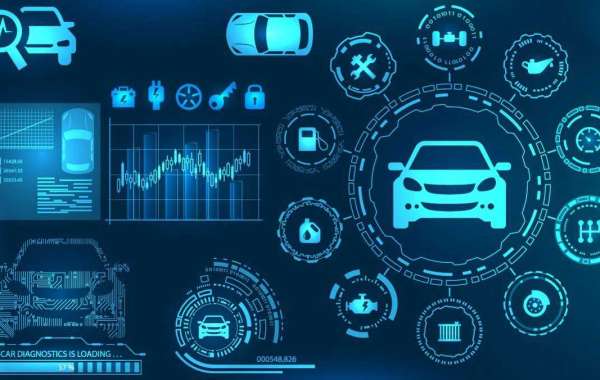
The automobile is undergoing a tectonic shift. Where mechanical engineering once dominated product differentiation, software now drives value creation, customer experience and long-term monetization. The modern vehicle is increasingly a distributed computing platform: sensors produce torrents of data, domain controllers run complex control and perception stacks, and cloud services manage updates, analytics and user services. This transformation — toward what many call the “software-defined vehicle” (SDV) — is the single most important change in the auto industry since the arrival of mass production. The Automotive Software Market sits at the heart of this transformation, growing not just in size but in strategic importance.
This article examines the market through multiple lenses: why software matters, the segments that capture most value, the technical and organizational hurdles OEMs and suppliers face, commercial models that are emerging, regional dynamics, and pragmatic recommendations for companies seeking to compete in a software-first automotive landscape.
Click Here to Download a Free Sample Report
Why software now matters more than ever
Three broad industry shifts explain the sudden centrality of software in vehicles:
- Electrification and architectural consolidation. Electric powertrains simplify mechanical complexity while increasing the role of control software for battery management, thermal systems, regenerative braking and charging management. At the same time, OEMs are consolidating dozens of ECUs into fewer, more powerful domain controllers. Consolidation raises the relative share of software in vehicle cost and capability.
- Connectivity and continuous improvement. Consumers expect their cars to receive updates, new features and personalization — just like smartphones. Over-the-air (OTA) software delivery turns vehicles into living products, enabling improvements after sale and unlocking recurring revenue streams.
- Safety, autonomy and sensing. ADAS and autonomous functions require sophisticated perception, sensor fusion, decision-making and control software. These stacks are computationally intensive and safety-critical, forcing OEMs to invest heavily in software engineering, verification and validation.
Together these trends redefine vehicle development, turning software not into a supporting function but the core product differentiator.
Market segments: where value concentrates
The Automotive Software Market is not monolithic. Value clusters in several segments, each with distinct technical demands and business models:
- ADAS & Autonomous Driving Software
This is the most visible, and arguably the most value-rich, segment. It includes perception (camera, radar, lidar processing), sensor fusion, localization, trajectory planning and control. ADAS software must meet stringent safety and latency requirements and often uses machine learning models that are continuously improved through fleet data.
- Powertrain & Energy Management
EVs elevate the role of battery management systems (BMS), motor-control algorithms, thermal management and energy-optimization software. These systems directly impact range, longevity and vehicle performance — key purchase factors for EV buyers.
- Infotainment & Digital Cockpit
Infotainment software focuses on UX, connectivity, voice assistants, app ecosystems and seamless smartphone integration. A compelling digital cockpit enhances perceived vehicle value and creates opportunities for software services and app marketplaces.
- Middleware, Operating Systems & Platform Software
This includes AUTOSAR-based stacks, real-time operating systems (RTOS), hypervisors and middleware that provide deterministic behavior, security primitives and safe partitioning of workloads. These components are foundational — other application software depends on them.
- Security, Identity & OTA Management
Secure boot, secure update chains, key management, intrusion detection and OTA delivery platforms are essential as cars connect to public networks. Safety and security are now tightly coupled: a compromised update or attacker in the vehicle network can have life-or-death consequences.
- Backend & Fleet Software
Telematics, fleet management, predictive maintenance, data pipelines and analytics platforms are increasingly important for commercial fleets and OEM service operations. They monetize data and optimize uptime and total cost of ownership.
Commercial models and monetization strategies
Software opens multiple revenue paths that change the OEM-customer relationship:
- One-time Sales: Traditional permanent feature unlocks (e.g., paid activation of a navigation module).
- Subscriptions: Time-limited access to features (e.g., enhanced ADAS capabilities for a monthly fee).
- Feature Trials & Pay-per-use: Trial periods that convert to paid subscriptions or pay-per-use features for specific needs (e.g., advanced parking assistance).
- Data Services & Fleet Monetization: Selling aggregated, privacy-compliant insights to fleet operators or partners, or offering predictive maintenance subscriptions.
- Software-as-a-Service (SaaS) for OEMs and Dealers: Platforms for updates, diagnostics or analytics sold to partners.
These models let OEMs earn recurring revenue, lock in customer ecosystems and offset hardware commoditization. However, they also introduce pricing, privacy and fairness questions that require careful handling to maintain consumer trust.
Technical challenges: the software engineering reality
Delivering safe, secure, high-quality automotive software is hard. Key technical obstacles include:
Safety & Verification
Safety-critical systems must comply with functional safety standards (e.g., ISO 26262) and, increasingly for autonomy, other frameworks. Verifying complex perception stacks, especially ML-driven components, requires vast simulation and real-world testing.
Real-time Determinism & Resource Constraints
Systems must meet deterministic timing guarantees — difficult when running large neural networks alongside traditional control loops on shared compute platforms. Resource scheduling, partitioning, and worst-case execution analysis are crucial.
Complexity of Integration
Consolidating many ECUs into domain controllers requires re-architecting software into modular, decoupled units. Interactions between subsystems (e.g., powertrain and ADAS) must be carefully managed to avoid emergent failures.
Cybersecurity
Automotive systems are attractive targets. Securing the entire lifecycle — from supply-chain integrity to secure update mechanisms and runtime monitoring — is essential and legally expected.
Tooling & Validation Infrastructure
Automotive software demands a sophisticated toolchain: CI/CD pipelines, hardware-in-the-loop (HIL) and software-in-the-loop (SIL) testbeds, digital twins and extensive simulation to accelerate validation and reduce physical testing.
Organizational and cultural change — not just technology
Shifting to a software-first product requires organizational evolution:
- Cross-disciplinary teams: Integrating software, hardware, safety and product marketing teams early in the development lifecycle.
- Agile and DevSecOps practices: Continuous integration, testing and secure delivery to minimize downtime between development and deployment.
- Talent & Skills: Recruiting software engineers, data scientists, security experts and cloud architects into a traditionally mechanical industry.
- Supplier relationships: Moving from part procurement to strategic partnerships with software vendors and cloud providers, with clear responsibilities for maintenance and updates.
Without these changes, companies struggle to release higher-quality software at the cadence modern customers expect.
Regional dynamics and ecosystems
Geography influences where different types of software and services flourish:
- North America: Strong in software platforms, ADAS/AI innovation, cloud services and startup ecosystems. Many Tier-1s and new entrants are headquartered here.
- Europe: Known for regulatory leadership, safety engineering, and high-value OEMs focused on premium segments and safety-critical software.
- Asia-Pacific: Particularly China, Korea and Japan, where manufacturing scale, sensor supply chains, and rapid EV adoption create demand for production-grade software and integration services.
Each region brings distinct strengths, and global OEMs often create hybrid strategies — developing core IP in one region while scaling manufacturing and data collection elsewhere.
Competitive landscape — incumbents and disruptors
The automotive software space features a diverse set of players:
- Traditional Tier-1s are evolving from hardware suppliers to full-stack software providers.
- Big Tech & Cloud Providers supply cloud services, AI tools and sometimes middleware that OEMs must integrate or compete with.
- Semiconductor companies provide edge compute platforms and software stacks optimized for ML inference and safety-critical workloads.
- Startups specialize in narrow but high-impact areas: perception, simulation, OTA, cybersecurity or data labeling and fleet AI.
Strategic alliances, acquisitions and co-development deals are common as incumbents try to combine scale with innovation speed.
Regulation, ethics and consumer trust
The legal and societal context matters. Regulators are paying more attention to software updates, cyber safety, right-to-repair issues and the use of data. Ethical questions around autonomous decision-making, data anonymization and monetization practices influence consumer trust and brand reputation. OEMs that prioritize transparent policies, clear consent models and robust security will be better placed to win long-term loyalty.
Near-term trends to watch
Several concrete trends will shape market dynamics over the next few years:
- Wider OTA adoption enabling faster fixes and feature rollouts, but requiring airtight security.
- Domain controller proliferation as OEMs consolidate compute and standardize software platforms.
- AI at the edge with optimized models running on vehicle processors for perception and driver assistance.
- Standardization efforts (software APIs, data formats, functional safety practices) to lower integration friction.
- Subscription experimentation as companies test pricing models and feature segmentation without alienating buyers.
Strategic recommendations for market participants
For OEMs, suppliers and startups, practical steps increase the odds of success:
- Prioritize platform thinking. Build or adopt modular platforms with clear interfaces and versioning strategies to accelerate feature delivery.
- Invest in verification and simulation. High-fidelity virtual testing reduces time-to-market and improves safety validation.
- Make security a product attribute. Design secure update chains, code signing and runtime monitoring from day one.
- Experiment with monetization carefully. Test subscriptions and feature unlocks with transparent communication and consumer choice.
- Cultivate data pipelines. Design data governance, labeling and MLOps pipelines early to derive value from fleet telemetry.
- Partner selectively. Outsource non-core capabilities but retain control of customer-facing experiences and safety-critical IP.
Long-term outlook — software as the vehicle’s soul
The automotive software market will expand in both scale and strategic importance. Vehicles will continue to converge toward horizontally integrated compute platforms running software stacks that evolve throughout the vehicle lifetime. Winners will not just be those with the best code, but those who combine engineering discipline, robust safety practices, consumer-centric monetization and nimble organizational cultures.
As cars become software platforms, the line between automotive OEMs, software companies and service providers will blur. Success will favor companies that can think in product lifecycles rather than one-off hardware sales — designing vehicles that improve, adapt and generate value well beyond the purchase transaction.
Conclusion
The move to software-defined vehicles is inevitable and disruptive. The Automotive Software Market is not a secondary supplier space anymore; it is the arena where brand differentiation, customer engagement and recurring revenue converge. Firms that embrace software-first engineering, secure and transparent business models, and investments in data and validation pipelines will lead this new era. For everyone else, the risk is to watch from the sidelines while competitors iterate faster, ship smarter and monetize more effectively.