
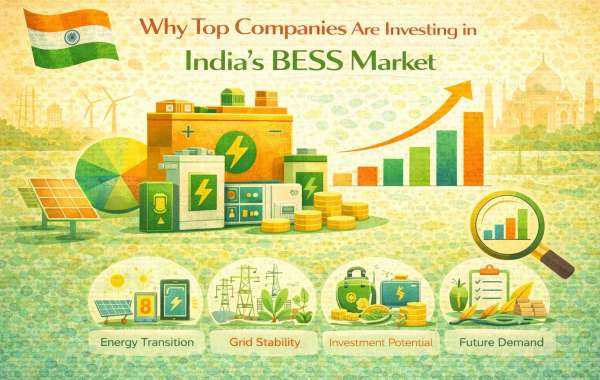
India has emerged as a country currently in the midst of an energy structural transformation based on developments in the scale of the expansion of renewables power generation, electric vehicles, and modern grid initiatives taken in the country. Amidst the crucial transition in India’s energy sector is the technology of battery energy storage systems that has now been recognized as a imperative need rather than a mere elective in the country. For this reason alone, homegrown and global industry players have been investing in India's BESS sector on an unprecedented scale.
Policy Push and Government-Led Market Enablement
One of the most compelling factors favoring growing investments by corporates is that Indian policy clearly backs the sector. Energy storage has clearly been identified as an element of vital importance and is complemented by supporting regulatory clarity and incentive measures. In fact, measures like conferring a legal form to energy storage systems and waiving transmission charges in inter-state grids have made energy storage an important element that has lowered barriers to market entry for private sector entities.
Additionally, there have been large-scale budgets through initiatives such as Viability Gap Funding to support projects in their bankability. Here, the government is willing to support projects involving up to 40% of the capital costs for large installations planned for the end of this decade. It is highly supportive of government programs such as the National Solar Mission and the National Mission for Enhanced Energy Efficiency to promote the adoption of non-fossil fuels.
This structured policy environment has transformed the India Battery Energy Storage System industry from an experiment to a well-predicted market for investment.
Market Size Expansion and Growth Economics
The market size is estimated at approximately 250 million USD in 2024, which is further expected to rise to nearly 1.2 billion USD by the end of 2030, growing at a robust CAGR of nearly 27% during 2025-2030. This rise is real, as the projects, tenders, as well as utility-scale projects, have begun.
A significant cause of economic growth has been the steep fall in battery prices in the last ten years, which has made BESS projects financially attractive due to moderating raw materials, efficiency gains in manufacture, and the globalization of lithium-ion production volumes. For one, tariffs have fallen steeply in state utility tendering compared to early days in national auctions, which has made energy storage financially attractive as a balancing supply in peak shaving capacity.
These pricing models are creating a larger India Battery Energy Storage System Scope because they invite the participation of several players including renewable developers, power distributors, EV developers, and independent power producers.
Grid Stability and Renewable Energy Integration
India’s renewable energy sources are expanding rapidly worldwide; nevertheless, solar and wind sources are intrinsically intermittent in nature. Batteries in the context of storing energy are of vital importance in solving the intermittency of sources.
The Tangibility of Commissioned Utility-Scale Storage Plants: The commissioning of utility-scale storage has shown positive results in many parts of the world already. For instance, India’s first commercial utility-scale BESS project in Delhi provides multi-hour-long energy services directly to stabilize the grid in peak demand situations in Delhi. Such models can already be replicated in other states where high levels of renewable energy integration exist in India.
Yet another measure to reinforce this trend is a key government initiative to dedicate huge funding to grid-scale storage facilities that have capacities measured in thousands of megawatt hours. These are measures to guarantee that power generated through renewable technology is not left unused because of issues regarding transmission.
Electric Vehicles and Low-Carbon Energy Transition
The rapid adoption of electric vehicles is creating a parallel demand driver for battery energy storage. With nearly two million EVs sold in India in 2024 alone, the pressure on charging infrastructure and local distribution networks has intensified. BESS installations help manage load fluctuations by storing energy during off-peak hours and releasing it during high-demand charging periods.
Beyond transportation, India’s broader low-carbon strategy is accelerating the need for storage solutions. The country aims to source 50% of its installed power capacity from non-fossil fuels by 2030, while also committing to net-zero emissions by 2070. Achieving these targets requires storage systems that can support an integrated, flexible transmission network.
The planned deployment of over 50 GW of battery storage capacity as part of India’s long-term transmission roadmap highlights the expanding India Battery Energy Storage System (BESS) Scope across both utility and commercial segments.
Environmental Challenges and Technology-Led Mitigation
Despite strong momentum, environmental concerns related to battery disposal and recycling remain a challenge. Improper handling of spent batteries—particularly lead-acid and lithium-ion—poses risks to soil, groundwater, and public health. With battery usage rising across EVs and grid storage, waste management has become a critical policy focus.
In response, the government is strengthening recycling mandates and extended producer responsibility frameworks. These regulations are encouraging companies to invest in closed-loop systems, advanced recycling technologies, and safer battery chemistries. For investors, this shift represents not a constraint but an opportunity to differentiate through sustainable operations and long-term compliance readiness.
Key Companies Driving Market Momentum
Multiple established players and budding innovators are energetically building the ecosystem in India. Among the major participants are Exide Industries Ltd., Delta Electronics, ABB India, Amara Raja Group, Luminous, Panasonic Corporation, Toshiba Corporation, AES Corporation, and Honeywell Automation India Limited.
These companies are focusing on large-scale deployments, lithium-ion advancements, grid integration software, and strategic partnerships with utilities and EV makers. Recent collaborations—such as agreements for cell supplies to electric vehicles and utility-backed storage projects—reflect a long-term commitment rather than short-term market entry.
This is further accelerating the adoption of technology, optimizing costs, and developing skills throughout the value chain.
Strategic Outlook for Investors and Stakeholders
India's BESS space is not an emerging concept; it has transitioned to the level of becoming fundamental energy infrastructure. Strong government support and decreasing battery costs have triggered a rare confluence in policy, technological, and economic developments.
Success in entry or expansion will be premised on the ability to engage with regulatory structures, scalable innovations, as well as partnerships in power, transmission, as well as mobility segments, with players that forge early entrants benefiting from long-duration contract offerings as well as a broad installed base that continues to grow exponentially.
Further insights for clientele regarding market sizing, competition analysis, and investments may be obtained through market research provided by marknteladvisors for this high-value segment.






